
Maxed Out Your 401(k)? Explore a Mega Backdoor Roth Strategy
Mega Backdoor Roth 401k
If you are already maxing out your 401(k), there may be another savings opportunity worth exploring inside your plan: the mega backdoor Roth
If your employer plan allows it, this strategy may let you contribute additional after-tax dollars to your 401(k), then convert those dollars to a Roth 401(k).
Why This Matters
Many high-income earners cannot contribute directly to a Roth IRA. For 2026, Roth IRA contributions are fully phased out once modified adjusted gross income reaches $168,000 for single filers or $252,000 for married couples filing jointly.
That is where the mega backdoor Roth can be powerful. Under current tax law, earnings in Roth accounts can grow tax-free, and qualified withdrawals may also be tax-free in retirement. Over time, that could mean meaningful tax savings and greater flexibility in retirement.
Who Should Pay Attention
This may be worth reviewing if you:
Already max out your 401(k)
Have extra cash flow from bonuses, equity vesting, or business income
Are phased out of direct Roth IRA contributions
Want more tax diversification in retirement
Are looking to increase Roth retirement savings.
How It Works
At a high level, the strategy has two steps:
Make after-tax contributions to your 401(k), above your regular pre-tax or Roth 401(k) deferral.
Convert those after-tax dollars to a Roth account, either inside the plan or through a rollover to a Roth IRA.
Types of 401(k) Contributions
For 2026, employees under age 50 can contribute up to $24,500 in regular pre-tax and/or Roth 401(k) deferrals. The overall 401(k) contribution limit, including employee, employer, and after-tax contributions, is $72,000. Eligible catch-up contributions may be made above this limit.
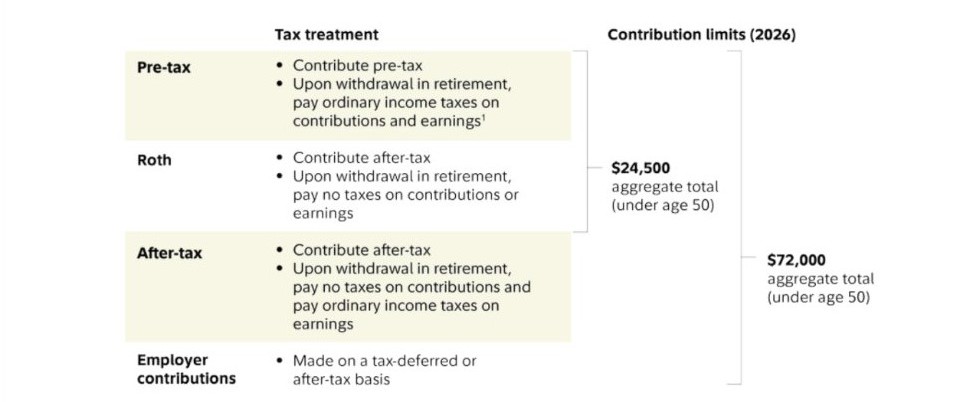
Image Source: Fidelity
A Few Planning Notes
Your 401(k) needs to allow after-tax contributions, plus either in-plan Roth conversions or in-service withdrawals to a Roth IRA. Some plans also offer automatic Roth conversions.
This is not a “set it and forget it” strategy. Employer contributions count toward the annual plan limit, plan rules vary, and earnings on after-tax contributions may create taxable income if converted later.
It should also be coordinated with your financial advisor, incorporating your broader financial picture, including cash flow, taxes, equity compensation, charitable giving, and retirement goals.
What To Do Next
If you are already maxing out your 401(k), check whether your employer plan allows after-tax contributions and Roth conversions.
If it does, this may be worth reviewing before year-end. Reach out and we can help determine whether the strategy fits your overall financial plan.
This material is for educational purposes only and is not intended as individualized tax, legal, or investment advice. Please consult your tax advisor and review your plan documents before implementing any strategy. Tax laws and contribution limits are subject to change, and eligibility depends on your employer's plan provisions.
Sources: Fidelity, “What is a mega backdoor Roth?” and IRS 2026 retirement plan limits.

